Attorneys Don’t Have a
Tax Prep Problem.

They Have a
Tax Strategy Problem.

Entity structure

Owner compensation

Estimated taxes

Retirement planning

QBI strategy

Entity structure • Owner compensation • Estimated taxes • Retirement planning • QBI strategy

If you’re an attorney or law firm owner
making strong income
but still feel like taxes are reactive,

we help you plan earlier, reduce surprises, save on taxes,
and make smarter tax decisions throughout the year.

For Attorneys and Law Firm Owners Who Want Proactive Tax Planning; Not Just a Return Prepared After the Fact.

Why Taxes Still Feel Frustrating

Even When Your Income is Strong:

Surprise
Balances Due

You find out what happened after the year is already over.

Reactive CPA
conversations

You hear advice after the window to act has closed.

Quarterly
Estimate Stress

You’re guessing instead of planning.

Owner
Compensation
Uncertainty

Salary, draws, and distributions are not tied to a strategy.

No Clear
Reserve System

You know taxes are coming, but not how much to set aside.

You Should Be
Further Ahead

High income does not automatically create financial clarity.

If taxes keep feeling rushed, painful, or harder than they should be, the issue is usually not compliance. It’s strategy.

The Issue Isn’t the Return.

It’s What Happened Before the Return:


Most attorneys have
been trained to think
about taxes at filing time.

But real tax strategy
happens earlier.
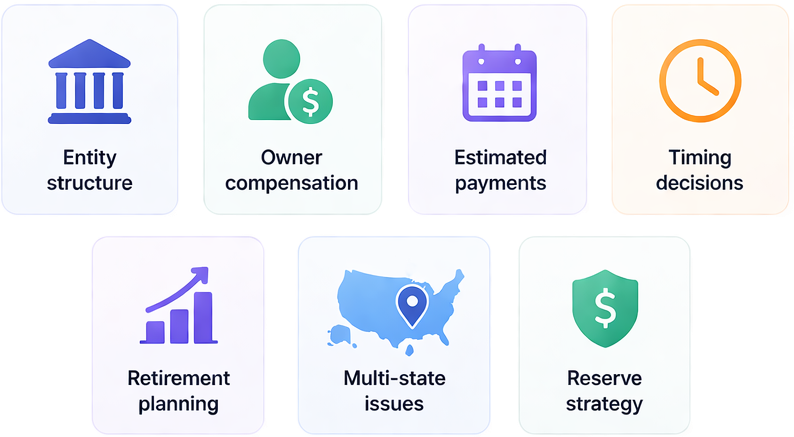
Entity structure. Owner compensation. Estimated payments. Timing decisions. Retirement planning. Multi-state issues. Reserve strategy.
Strategy During the Year: Make informed decisions. Adjust before deadlines. Lower taxes legally. Create financial clarity. Post-Mortem at Tax Time: Look backward. Missed opportunities. Higher tax bills. More stress
If no one is helping you think through those during the year, tax season tends to become a post-mortem instead of a plan.

Meet:

Mark Kasminoff, CPA, J.D.

Mark has over 25 years of experience working in the accounting and tax field, and has built an excellent reputation for quality service and personal attention.

He has a Bachelor’s Degree in Accounting from the University of Nevada Las Vegas, is Certified as a Public Accountant, and earned his Juris Doctor Degree from William S. Boyd School of Law in May 2020.

You're Handing the IRS $13,400 Every Year

That You Don't Legally Owe

Most solo attorneys file as sole proprietors and pay self-employment tax on every dollar they earn.

There's a simple, legal fix; the only reason most attorneys aren't using it is because
nobody told them before April.

Case Study — Solo Attorney S-Corp Tax Savings, 2026
Kasminoff & Associates, CPA

Case Study: Solo Attorney S-Corp Tax Savings

2026 illustration · $280,000 total income · $120,000 S-corp salary · $160,000 distributions

Total income
$280k
scenario income
Sole proprietor
$31,718
SE tax + Additional Medicare
S-corp structure
$18,360
payroll tax on salary
Estimated savings
$13,358
approximately $13,400
Without planning
Sole proprietor / Schedule C
Total income subject to SE tax model$280,000
2026 Social Security cap$184,500
Social Security tax at 12.4%$22,878
Medicare tax at 2.9%$8,120
Additional Medicare tax at 0.9%$720
Total SE / Medicare tax$31,718
With S-corp election
S-corp salary + distributions
Reasonable W-2 salary$120,000
S-corp distributions$160,000
Social Security tax at 12.4%$14,880
Medicare tax at 2.9%$3,480
Additional Medicare tax$0
Total payroll tax$18,360
Calculation detail
Sole proprietor
Social Security: $184,500 × 12.4% = $22,878
Medicare: $280,000 × 2.9% = $8,120
Additional Medicare: ($280,000 - $200,000) × 0.9% = $720
Total: $22,878 + $8,120 + $720 = $31,718
S corporation
Social Security: $120,000 × 12.4% = $14,880
Medicare: $120,000 × 2.9% = $3,480
Additional Medicare: $0 because the W-2 salary is below $200,000
Total: $14,880 + $3,480 = $18,360
Estimated SE / FICA savings with S-corp $13,358, or about $13,400
SE and FICA tax comparison $0 $10k $20k $30k $35k $31,718 $18,360 $13,358 Sole proprietor SE + Additional Medicare S-corp structure Payroll tax on salary Estimated savings Approx. $13,400 SE tax + Additional Medicare S-corp payroll tax Estimated savings
Key takeaway: because the 2026 Social Security cap is higher, more sole proprietor income is exposed to the 12.4% Social Security portion of self-employment tax. In this simplified example, the S-corp structure avoids SE / FICA tax on $160,000 of distributions and avoids the $720 Additional Medicare tax that appears in the sole proprietor model.
Planning window: the S-corp election generally needs to be reviewed before the election deadline. A year-round advisor can evaluate salary, distributions, entity structure, estimates, and filing status before the window to act has already closed.
Illustrative example only. This uses the simplified assumptions shown above and assumes the taxpayer is subject to the $200,000 Additional Medicare threshold. Actual results depend on filing status, reasonable compensation, entity structure, state taxes, retirement plan design, qualified business income rules, other income, and current tax law. This illustration does not apply every possible self-employment tax adjustment or income-tax effect.

¹This is based off the provided example case study. Individual savings may very.

Your CPA said you're over the limit.

They weren't wrong.

They just stopped too soon.

A 20% tax deduction exists for law firm owners, but it phases out at higher income
Most CPAs see that and move on.

A proactive advisor models what it takes to get back into range before December 31.
One retirement contribution can pays for itself in federal tax savings.²
That contribution pays for itself.

Case Study — Law Firm Owner QBI Planning, 2026
Kasminoff & Associates, CPA

Case Study: Law Firm Owner QBI Planning

2026 illustration · $420,000 taxable income before QBI deduction · Married filing jointly · Pass-through legal practice

Taxable income
$420k
before QBI deduction
2026 MFJ threshold
$403.5k
QBI limitation begins
Estimated QBI deduction
$74,760
at $420k income
QBI gap to model
$5,940
additional deduction potential
Full SSTB eligibility zone
At or below $403,500 MFJ, the SSTB phase-out limitation does not reduce the deduction.
Phase-out zone
$403,500 to $553,500 MFJ. Legal-service income can still qualify, but only partially.
Fully phased out
Above $553,500 MFJ, QBI from a law practice is generally unavailable for the deduction.
Current position — $420,000 taxable income
What the phase-out does
Amount over 2026 MFJ threshold$16,500
Phase-out range$150,000
SSTB phase-out percentage11%
SSTB percentage still eligible89%
Estimated allowed QBI deduction$74,760
Planning target
What proactive planning can change
Income-reduction target to model$16,500
Target taxable income threshold$403,500
Threshold-level QBI deduction estimate$80,700
Additional QBI deduction potentially unlocked$5,940
Planning windowBefore December 31
Calculation detail
At $420,000 taxable income
Excess over threshold: $420,000 - $403,500 = $16,500
Phase-out percentage: $16,500 / $150,000 = 11%
Eligible SSTB percentage: 100% - 11% = 89%
QBI deduction: $420,000 × 20% × 89% = $74,760
If planned down to the threshold
Target taxable income: $403,500
Taxable-income cap: $403,500 × 20% = $80,700
Additional QBI deduction: $80,700 - $74,760 = $5,940
Tax value depends on final bracket and full return facts.
Planning insight At $420k, the deduction may still be available - but planning matters.
2026 QBI phase-out map for MFJ legal practice owner 2026 QBI Phase-Out Map — Married Filing Jointly Legal practices are generally treated as specified service trades or businesses. $420k current example $0 $403,500 $553,500 higher full eligibility partial eligibility phased out $80,700 threshold-level estimate $74,760 at $420k income $5,940 QBI gap to model Threshold-level QBI deduction estimate Estimated QBI deduction at $420k Additional deduction opportunity to model
Key takeaway: at $420,000 of taxable income, a law firm owner may still have access to a meaningful QBI deduction under the 2026 MFJ thresholds. The question is not simply whether you are “over the limit.” The better question is whether year-end planning can improve the eligible percentage, reduce taxable income, and create a more predictable tax result.
Planning window: this type of modeling is most useful before year-end, while there is still time to act. Potential levers may include retirement plan design, timing of cash-basis receipts and expenses where permitted, charitable planning, entity-level deductions, and coordination with wage, spouse-income, and state-tax issues. The right strategy depends on the full facts of your return.
Illustrative example only. This example assumes a married filing jointly taxpayer, no net capital gain limitation, $420,000 of taxable income before the QBI deduction, and enough QBI to support the calculation shown. Actual QBI results depend on filing status, net capital gains, qualified business income, W-2 wages, UBIA of qualified property, business type, retirement plan design, other income, state taxes, and current tax law. Legal services are generally treated as a specified service trade or business for Section 199A purposes.

²This is based off the provided example case study. Individual savings may very.

Reactive vs Strategic Tax Prep:
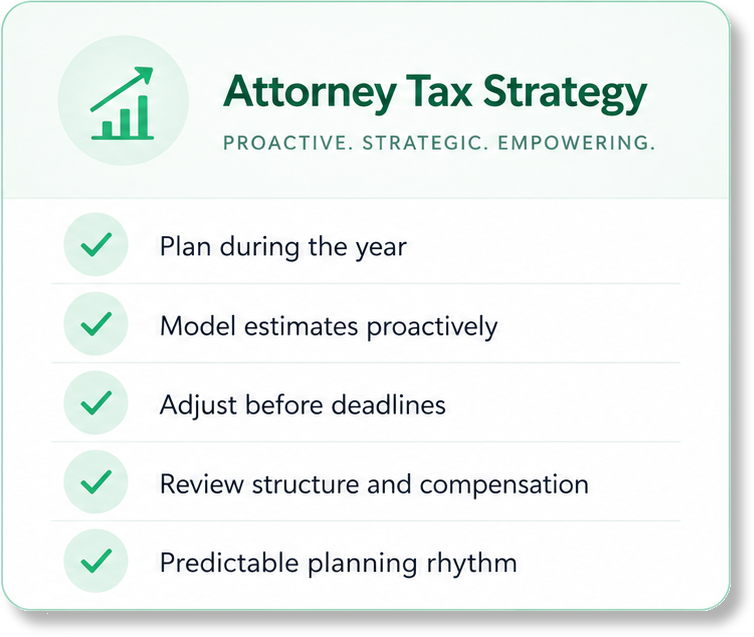
Attorney Tax Strategy. Plan during the year. Model estimates proactively. Adjust before deadlines. Review structure and compensation. Predictable planning rhythm.
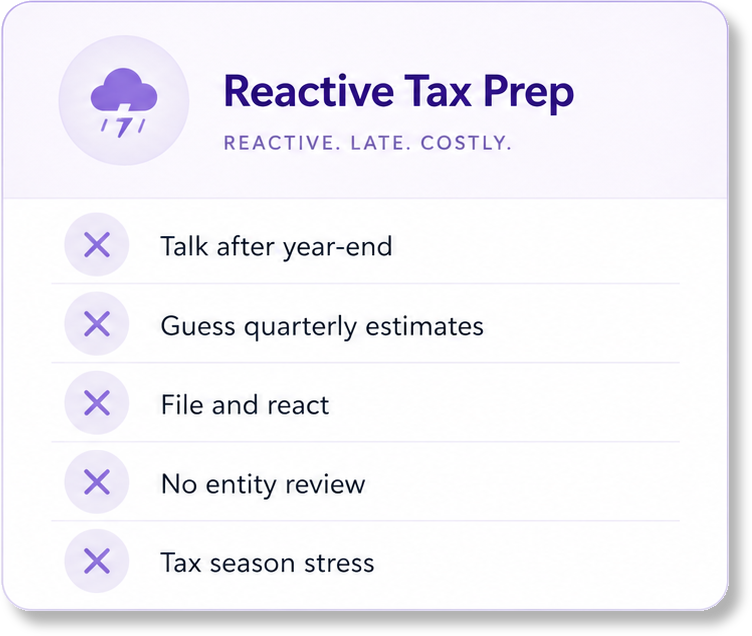
Reactive Tax Prep. Talk after year-end. Guess quarterly estimates. File and react. No entity review. Tax season stress.

Who’s This For:

Solo attorneys with growing income
Law firm owners
Small firms with partners
Attorneys who have had surprise tax bills
Attorneys who want proactive tax planning during the year
Attorneys who feel like their current CPA relationship is too reactive
Attorneys whose income, entity structure, or state filings are getting more complex
Attorneys who feel as if they are paying too much in taxes

If you’re only looking for the cheapest once-a-year return preparation, this is probably not the right fit.

How the Process Works:

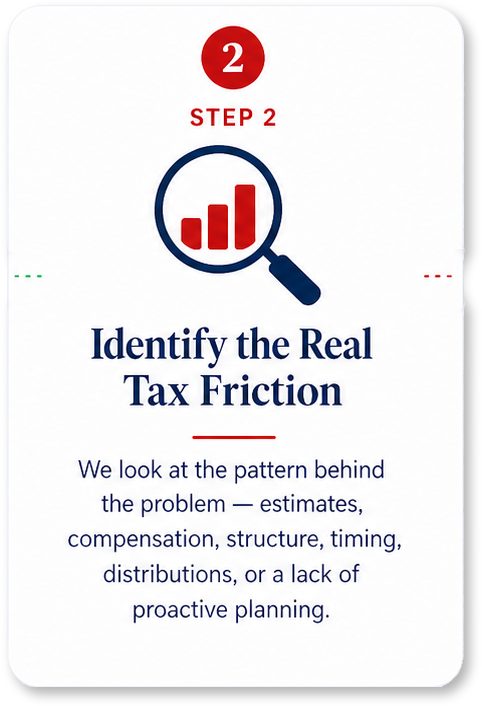
We Are Not Built Around Once-a-Year Tax Prep.

With Mark’s 25+ years of experience and a proactive tax advisory team, attorneys choose us because we help them think ahead; not just react at filing time.

What We Do Differently:
Ask the right tax questions earlier
Review key decisions before deadlines pass
Adjust during the year as income and circumstances change
Avoid the cycle of reactive tax decisions
Identify legal opportunities to reduce what you owe
Create a more predictable tax planning process

For many attorneys, that is the difference between simply getting returns filed and actually having a tax strategy.

Why Attorneys Choose a Strategic Approach:

Attorneys are used to thinking in terms of structure, risk, timing, and documentation.

Taxes should be approached the same way.

Structure
Risk
Documentation
Timing
A strategic model is different: Plan during the year. Review the moving parts early. Make decisions while they still matter. Create a more predictable tax process. Save Money.
The old model is reactive: Earn the income. Hope estimates are close. File the return. Deal with the outcome.

The difference is not just filing the return. It’s making the right decisions while they still matter.

That shift is often what makes taxes finally feel manageable.

Frequently Asked Questions:
Do you only work with attorneys?

For this page and process, yes.
This service is designed specifically for attorneys and law firm owners, with planning tailored to legal practices and high-income attorney households.
Is this just tax return preparation?

No.
The focus is proactive tax planning and advisory support during the year, not just preparing returns after year-end.
What if I already have a CPA?

That’s common.
Many attorneys already have a CPA. The key question is whether proactive planning is happening early enough and often enough to improve outcomes.

What if I'm not sure I need ongoing help?

That’s exactly what the initial call is for.
We can quickly determine whether your situation is a one-time issue or something that would benefit from ongoing planning support.

Who is the best fit?

Attorneys and law firm owners with solid income, growing complexity, and a desire for more proactive tax planning are usually the best fit.

Avoid Missed Strategies in April: